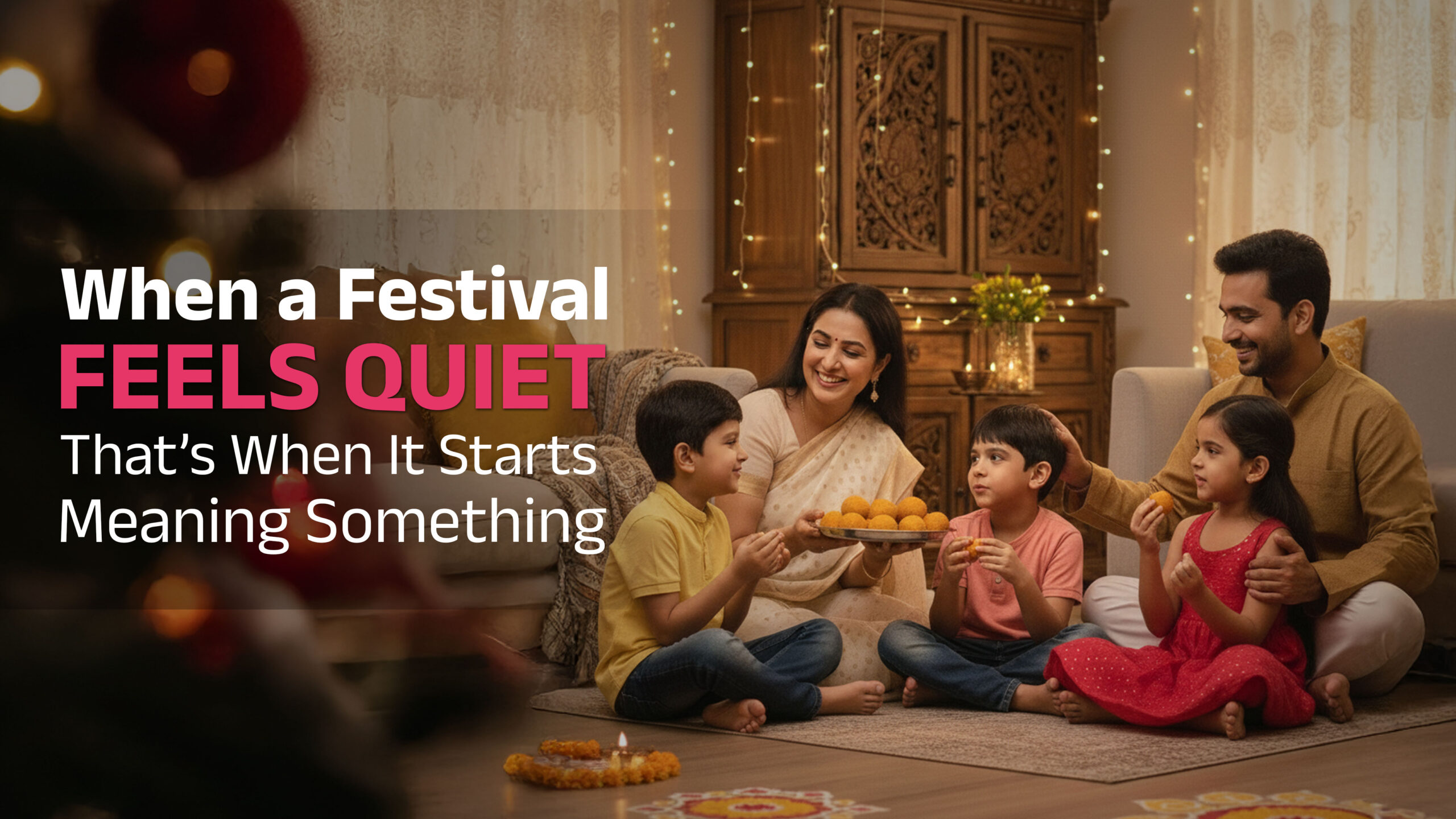
Not every festival feels loud.
Some pass without fireworks. Without crowds. Without long plans or packed schedules. And strangely, those are often the ones that stay longer in memory.
A quiet festival can feel underwhelming at first. There’s less noise. Fewer people. Fewer things to do. It almost feels like something is missing. That feeling makes many people uneasy. We’ve learned to associate celebration with activity, with movement, with proof that something happened.
But when the noise drops, something else becomes noticeable.
When “Quiet” Makes It More Visible
Quiet festivals slow people down.
Conversations stretch longer. Meals take more time. People sit without checking the clock. There’s less pressure to perform the day and more space to simply be in it.
That space is uncomfortable for some. Silence has a way of bringing thoughts forward. Memories surface. Absences feel clearer. Not everyone experiences festivals as joy, and quiet makes room for that truth too.
In loud celebrations, emotion gets diluted. Everyone is busy. The schedule carries the day. Quiet festivals don’t have that buffer. They ask more from the people present. They ask you to notice who’s there and who isn’t.
How Inclusion Happens Without Planning
This is often when inclusion happens naturally.
Not the announced kind. Not the organised kind. Just the simple act of pulling up an extra chair. Sharing food without planning. Sitting with someone who might otherwise be alone.
Quiet makes these moments possible. Noise crowds them out.
It’s also when festivals start to reflect what they were always meant to hold. Shared rituals. Presence. Community that doesn’t need to be displayed. This idea of living heritage, where meaning is carried through people and moments rather than spectacle, is something many cultural traditions still preserve.
How a Quiet Festival Changes the Experience for Children and Adults
There’s something about quiet festivals that changes how children experience them.
Without spectacle, they focus on people. On stories. On small rituals. On watching adults closely. Those impressions stay longer than decorations ever do.
Adults, on the other hand, often measure festivals by output. How many people came. What was done. How it looked. Quiet festivals don’t give much to measure. They don’t perform well on the outside.
But inside, they do more work.
When Celebration Becomes Reflection
Quiet festivals remind people that celebration isn’t always about excitement.
Sometimes it’s about presence. About acknowledging time passing. About marking a moment without trying to fill it completely.
In many homes, quiet festivals happen unintentionally. A year when plans fall through. A year when someone is missing. A year when energy is low. These festivals are rarely spoken about later, but they often shape how people think about meaning.
They strip celebration down to its basics.
Who are we with.
What are we grateful for.
Who needs to be seen today.
These questions don’t need loud answers.
Why Quiet Does Not Mean Empty
Quiet festivals also reveal something else.
Joy doesn’t always announce itself. Sometimes it settles in slowly. In shared silence. In familiar routines. In doing less, together.
That kind of joy is easy to miss if you’re waiting for it to look a certain way.
When a festival feels quiet, it doesn’t mean it failed. It often means it shifted. From something outward to something inward. From performance to connection.
This way of thinking about celebration sits at the heart of what Festivals for Joy continues to explore and hold space for.
Closing Thought
Quiet festivals don’t try to compete. They don’t try to prove anything.
They show who stays without being entertained. Who listens without distraction. Who shares without needing recognition.
Those moments rarely feel impressive in real time. But they’re the ones people recall later, often unexpectedly.
When the lights go off.
When the day ends.
When the calendar moves on.
Quiet festivals don’t demand attention. They simply hold space.
And sometimes, that’s exactly where meaning starts.